Friday, March 4, 2022

10mm Zulu

 A project that I embarked on prior to the Pendraken Painting Competition was a smallish Anglo-Zulu War project for Daniel Mersey's The Men Who Would Be Kings (TMWWBK). I vacillated between 6mm and 10mm but opted to go with the latter. Almost all of my figures are from Old Glory's 10mm range supplemented by some Pendraken. In TMWWBK, a Zulu unit is comprised of 16 figures. I decided to use the rules as-is but with several smaller figures on a base that would normally have a single 28mm figure so I could get a nice massed look. I decided to base them on 20mm rounds and movement trays (all ordered from Litko).

Anyway, I am finished two married regiments, here is the uThulwana regiment also known as the Dust Raisers (EDIT: upon closer review of the image, this is actually the amaPhela regiment aka "Cockroaches")


Here is a closeup of one of the Litko movement trays I custom ordered. The uThulwana regiment had a white shield with brown spots.

The second regiment is that of amaPhela or the "Cockroaches". I decided to go with this regiment because I like the brown shield and their nickname. 

The two regiments massed in all of their glory. 96 total figures. I have one more married regiment and three more unmarried regiments to complete my Zulu army. Then its on to the British and their native contingents.

I have to say I really enjoy painting the Old Glory Zulus. They are relatively simple sculpts but they are incredibly easy and quick to paint and have about 6 dynamic poses. This project is all about speed painting to a wargames standard and getting them table ready. Look forward to the next regiment!

Sunday, February 27, 2022

Mystery Uniform

 A friend of mine sent me the following picture of his wife's great grandfather seeing if I could identify the uniform. The only clues I was given was that family was from the Baltic/Polish and the photo was around 1900. I'm thinking the cap and badge might give something away, I'm thinking maybe a mounted gendarmie or something? Can anyone assist?


Wednesday, February 23, 2022

James Scott, Duke of Monmouth

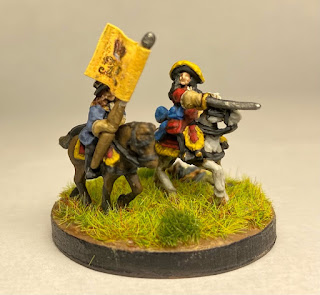
I managed to paint the final piece for the 2022 Pendraken Painting Competition. This one will be entered into the Single Base category. For this entry, I chose to paint up a command stand for the rebels at Sedgemoor. The stand consists of James Scott, Duke of Monmouth charging into the fray alongside a cornet from his Lifeguard who is carrying a flag with the Duke's royal cypher on a gold background. 

For inspiration, I chose this painting of the Duke in a red coat faced white with a blue sash, riding a white charger.


Here is my version, a bit simplified:


Pendraken offers up a lot of mounted command types in wonderful poses but I only possessed one of these sculpts, so the same pose serves double duty as commander of Grey's troop of horse. I actually like this pose for Monmouth as it captures the dash and elan I associate with him. 


Here is a different angle, you can see the cypher a bit better and you can also see a casualty of the uprising. The Duke himself seems rather indifferent to the plight of his fallen man on the ground. So that bring a conclusion to my painting for this competition. I managed to paint three entries in 3 weeks: Colonel Brandt's scythe battalion, Lord Grey's troop of horse and the dashing Duke himself. It was a fun and challenging mad dash to the finish line but I am glad I can relax a bit. I will probably snap a few pics of my British Para force for the Falklands and enter that into the Army category. 


Sunday, February 20, 2022

More Pendraken Painting Competition 2022!

I finished painting my second unit for the Pendraken Painting Competition. This entry will be for the "Mounted" category and it depicts Grey's Horse, a rebel cavalry formation during the Monmouth Rebellion. I decided to keep to the theme of my initial entry, which was Colonel Brandt's Scythe battalion at the battle of Sedgemoor. 


Grey apparently wasn't the initial leader of Monmouth's cavalry. Grey, while brave wasn't terriblt experienced and he failed to press home his attack across the rhine on the British camp. Had he been more aggressive, who knows what would have happened. As befitting a hastily gathered rebel army, I depicted these riders in a hodgepodge of clothing and gear. There are a smattering of the purple faced red coats that Monmouth brought over with the initial invasion force.


I also decided to add some of the Falklands stuff I painted up in 2021. I painted the Argentine infantry in late 2020 and early 2021 and then tackled the British Para infantry and the vehicles in mid 2021. First up is an Argentine Panhard armored car.


Next up is a British Scimitar (or is it a Scorpion? I think its a Scimitar..). These were fun to paint, I added some antenna sourced from old toothbrush bristles. 


Lastly, I have included a British Para platoon (minus the support weapons). I have to give credit to Doug from Dougie's Wargaming Blog. He provided the roadmap on how to paint the DPM camo.


Well, that's it for now. I am currently working on my final entry for the painting competition which is none other than the Duke of Monmouth himself! Wish me luck, I only have a week left to get him done!

Saturday, February 12, 2022

Pendraken Painting Competition 2022

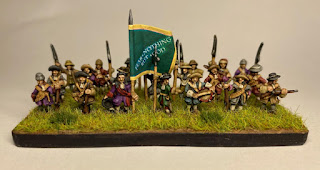
 Here is my entry for the Pre-20th Century Foot category, Colonel Brandt's scythe battalion at the battle of Sedgemoor. In Stephen Carter's recent work, Fighting for Liberty, the author notes that many of the scythe companies were possibly converged with the Lyme independent company to form an honor guard of sorts. Carter also notes that the "Fear Nothing But God" battle standard was recovered near where the scythe battalion would have been positioned and may have accompanied the scythes.


I tried to go with a subdued color palette to reflect the tradesmen that would have mustered into Monmouth's army. There are a few purple coats faced red mixed in to represent the coats distributed to the original rebel soldiers. There are also some red and grey militia coats sprinkled in for good measure.


I created the flag from merging several different images in MS Paint and then resizing and tweaking the contrast and brightness in MS Powerpoint. After mounting it, I had to touch it up a bit. I should say that I acquired these figures from the prizes I won in the 2015 painting competition. Last year I entered some Falklands Argentines that placed, hopefully these gents have similar success! I hope to paint and enter some additional entries before the deadline. Wish me luck!


Monday, September 20, 2021

Cannon, Cross and Crescent Play Test

I finished up my initial 1/2400 Tumbling Dice renaissance galley Turkish and Christian fleets so I decided to play a very small play test of David Manley's Cannon, Cross and Crescent ("CCC") quickplay rules for the period. 

A little about CCC. They are, as mentioned, quickplay and have some DBx feel to them. Ships have factors for heavy and light guns, boarding, stoutness, movement and turning ability (there are a few others). Different types (and nationalities) of ships have different values for these factors to reflect how the ships were constructed and how their peoples like to fight. 

Heavy guns have a 6" range and light guns 3". Light guns have a much wider arc of fire however. Shooting combat is straight forward: roll a dice, add your gunnery factor and any other modifiers and your opponent rolls a dice and adds it to his ship's stoutness factor. If you win small, expect some damage or crew casualties. If you win big, you may wreck your opponent outright. Boarding is similar: get stuck in, roll to attempt boarding (anything but a "1" is good to go), roll dice and compare boarding factors and modifiers. 

A turn is comprised of a command phase where you attempt to make repairs and check morale among other things which is followed by a series of action phases (3 action phases per side). You determine which side's action phase it is by drawing a card. I opted for a randomly drawn colored die (I had three red dice for the Turks and three white dice for the Spanish). This creates some additional uncertainty from the normal IGO/UGO system.

Here is the Turkish fleet comprising of three light galleys and one regular galley (2nd from bottom), the Turkish fleet is also accompanied by four bases of small boats. In the CCC rules, these can tag along to the big ships and add their manpower to boarding actions. The Turks are already fairly powerful with boarding actions as it is, so you know what they will want to do...

The Christian fleet, comprising of two galleys and two light galleys. For today's game I opted to make them Spanish. The Spanish are strong in boarding and have good firepower for their light guns. The light galleys don't have heavy guns however...no small boats for the Spanish since they have two regular size galleys in this fight.

Here is the relative dispositions of the fleets looking from the Spanish side of the table.

No real tactics will be on display for this play test, Don Juan and Barbarossa are probably very disappointed in the simple scrum planned. The fleets close in to each other...

The fleets close in on each other. At this point you may notice little white beads on the starboard bows of the center Spanish galleys and a black bead on the port stern of the Turkish galley. Let me explain...in CCC, you will want to denote a few situations/status of ships: who has fired heavy guns, which ships have suffered crew casualties (halving your boarding factor) and which ships have suffered damage (halving both boarding and gunnery factors). To keep bookkeeping to a minimum, I have small pegs inserted onto 3 of the 4 corners of the ship base. I place a small plastic Perler bead on these pegs to show status. The white pegs show the Spanish galleys have fired their large guns and one of those salvoes damaged the Turkish galley (black bead).

The fleets have come to grips with each other. The Turks closed in and were successful in boarding attempts on three of the four attempts (the light galleys on the far right came close but didn't make contact). The Spanish light galley on the far left has suffered damage when the Turks fired their heavy guns on contact.

Based on the prevalence of the yellow beads, you know something has happened! The yellow beads indicate crew casualties. If you notice the Spanish light galley has been replaced by a near sinking wreck. From what I recall, they were previously damaged and had crew casualties. They took a second crew casualty which turns to a damage but since they were already damaged, they became a wreck!

The beginning of the 2nd turn saw the end of the battle. Three compromised Turkish ships ganged up on the left Spanish galley, damaging it and inflicting crew casualties. On the right , the remaining Spanish light galley was captured when it was finally boarded by the Turkish light galley who then backed up and fired its heavy guns into the right Spanish galley. 

With both of their light galleys lost and the remaining galleys damaged along with crew casualties, I decided to call the battle and declare the Turks the winners. The Turkish fleet lost two bases on small boats but that's it... The game only lasted a turn and a half and went for about 30 or so minutes.

I'm sure I did some things wrong but I still had a blast. I will reread through the rules and run another play test. I highly recommend these for simple but nuanced renaissance galley combat.